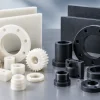
In high-precision mechanical engineering, power transmission gears demand uncompromising mechanical strength, low friction, and exceptional dimensional stability. While conventional engineering thermoplastics like Nylon (PA6/PA66) and Polyacetal (POM) have traditionally dominated industrial power transmission, severe operating environments often reveal their critical limitations—such as moisture-induced pitch swelling or center-line voids. Enter PET-H (High-Crystallinity Homopolymer PET), an advanced semi-crystalline thermoplastic engineered specifically for strict tolerance compliance and long-term dynamic loads.
What is PET-H (High-Crystallinity Homopolymer PET)?
PET-H represents a refined polymer modification of unreinforced Polyethylene Terephthalate. Unlike standard copolymer formulations, PET-H utilizes a specialized homopolymer structure paired with controlled thermal annealing process to maximize crystalline alignment within its molecular chains.
This boosted crystallinity alters the polymer matrix, yielding higher surface hardness, superior wear resistance, elevated tensile strength, and minimal continuous creep under heavy continuous torque. When extruded into high-density PET-H Sheets, the material provides a dense, void-free foundation tailored for high-precision CNC gear milling and spline cutting.
The Critical Factors for Gear Stability: Why PET-H Outperforms
1. Ultra-Low Water Absorption & Zero Swelling
Atmospheric humidity and direct moisture exposure remain the primary failure modes for gear pitch variation. Traditional polyamides absorb high volumes of environmental water (up to 8.0%), causing pitch diameter swelling, dynamic binding, and accelerated backlash failure. PET-H exhibits a 24-hour water absorption rate under 0.1%, keeping pitch lines precise across humid processing plants and outdoor machinery.
2. Superior Resistance to Centerline Porosity
While Acetal Homopolymer (POM-H) offers high rigidity, thick plate stock often suffers from centerline porosity caused by outgassing during cooling. When teeth are milled deep into the sheet core, these voids compromise root strength and spark micro-fractures under dynamic load. High-quality homopolymer PET-H sheet materials ensure a homogenous micro-density from skin to core.
3. Low Thermal Expansion & High Creep Endurance
Dynamic friction generates localized heat at tooth contact points. PET-H features a reduced coefficient of linear thermal expansion (CLTE) and higher heat deflection temperature (HDT) compared to POM-C, minimizing thermally induced profile distortion under continuous high-speed duty cycles.
Technical Comparison: PET-H vs. Standard Gear Plastics
To evaluate material suitability for precision gearing, consider the physical and mechanical performance metrics comparing PET-H against typical gear-grade polymers below:
| Property Metric | PET-H (High-Crystallinity) | POM-C (Acetal Copolymer) | PA66 (Nylon 6,6) |
|---|---|---|---|
| Moisture Absorption (24h Saturation) | < 0.1 % | ~ 0.2 % | 2.5 % – 8.5 % |
| Tensile Strength at Yield (MPa) | 85 – 95 | 65 – 70 | 75 – 85 |
| Flexural Modulus (GPa) | 3.3 – 3.6 | 2.8 – 3.0 | 2.8 – 3.2 |
| Centerline Porosity Risk | Extremely Low / None | Low | Moderate |
| Dimensional Tolerance Stability | Outstanding | Good | Fair to Poor |
Precision Machining Guidelines for PET-H Gears
Working with high-crystallinity thermoplastic shapes requires specific machining best practices to achieve sub-millimeter tolerances:
- Tooling Selection: Use sharp, un-coated carbide or diamond-tipped tools with high positive rake angles to prevent heat buildup and edge chipping.
- Coolant Usage: Air mist or water-soluble coolants are highly recommended to evacuate chips rapidly and suppress thermal expansion during tight-tolerance gear hobbing.
- Stress Relieving: For high-module gears with significant material removal, pre-machining or intermediate stress-relieving heat cycles help unlock stress-free stability.
Key Industrial Applications for Precision PET-H Stock Shapes
Beyond spur, helical, and bevel gears, high-crystallinity homopolymer PET shapes are widely implemented across specialized industries:
- Food & Pharmaceutical Packaging: High chemical washdown resistance and non-staining surface properties.
- Medical Device Actuators: Silent drive gear mechanisms requiring tight backlash control without lubrication.
- Automotive Assembly Equipment: Heavy-duty drive rollers, guide starwheels, and high-load wear pads.
Explore our complete catalog of Modified Materials to inspect specialized thermal, static-dissipative, or wear-enhanced polymer options.
Frequently Asked Questions (FAQ)
Q1: Why choose PET-H over standard POM-C for gear production?
While POM-C is a capable general-purpose plastic, PET-H provides significantly higher mechanical strength, higher modulus of elasticity, and approximately half the moisture absorption rate. This makes PET-H superior for fine-pitch precision gears demanding tight tooth engagement without backlash variance.
Q2: Can PET-H be used in wet or submerged environments?
Yes. PET-H exhibits near-zero hydrolytic swell under ambient water temperatures, holding its shape and pitch dimensions far better than nylon or acetal choices in marine, fluid-handling, or washdown environments.
Q3: Does CYLEX supply custom dimensions for non-standard gear stock?
CYLEX specializes in industrial engineering plastic stock shapes. We supply high-density PET-H sheets and custom modified polymers tailored to your exact mechanical drawing requirements.
Partner with CYLEX for High-Precision Engineering Plastics
Ready to upgrade your power transmission performance or need raw material selection support for custom gear stock? Visit our Contact Us page to get in touch with our technical polymer engineers and request a custom B2B inquiry quote today.