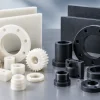
Dynamic sealing environments in aerospace, automotive, hydraulic, and chemical processing industries push engineering materials to their absolute physical limits. Standard sealing materials often fail under continuous friction, elevated operating temperatures, and aggressive media contact. To overcome these constraints, mechanical design engineers increasingly rely on polymer compounding solutions—specifically PTFE/PI (Polyimide) blends.
By compounding standard PTFE (Polytetrafluoroethylene) with high-performance Polyimide (PI) fillers, material scientists create a synergistic composite that addresses the fundamental weaknesses of virgin PTFE while retaining its extraordinary chemical resistance and lubricity.
The Engineering Challenges of High-Temperature Dynamic Seals
Dynamic seals—such as rotary shaft seals, reciprocating piston rings, and hydraulic rod seals—must operate under severe mechanical and thermal dynamic stresses:
- High Friction & Heat Generation: Continuous contact surfaces generate friction heat, accelerating thermal degradation and micro-cracking.
- Creep & Cold Flow: Unfilled PTFE tends to deform or “cold flow” permanently under continuous compressive dynamic loads, leading to seal failure and fluid bypass.
- Abrasive Wear & Extrusion: High system pressure forces dynamic seal lips into clearance gaps unless reinforced with durable, rigid fillers.
Why Combine PTFE with Polyimide (PI)?
PTFE/PI (Polyimide) engineered blends synthesize the best properties of both thermal polymers:
- Ultra-Low Friction & Self-Lubrication: PTFE serves as a solid lubricant matrix, dramatically reducing friction and initial breakaway torque.
- Superior Wear Resistance: Polyimide particles increase surface hardness and wear resistance up to several orders of magnitude compared to unfilled PTFE.
- Non-Abrasive to Soft Mating Surfaces: Unlike glass-filled or carbon-filled PTFE grades, Polyimide fillers are soft enough not to score or scratch soft metal shafts like bronze, aluminum, or stainless steel.
- High Temperature Dynamic Stability: Polyimide remains structurally sound up to 260°C to 300°C (500°F–572°F continuous), keeping the seal dimensions intact during severe heat spikes.
Technical Comparison: Virgin PTFE vs. PTFE/PI vs. PEEK
Selecting the right dynamic sealing polymer requires balancing mechanical strength, wear rate, and thermal performance. The technical matrix below highlights key property comparisons:
| Material Grade | Max Continuous Temp (°C) | Coefficient of Friction (Dynamic) | Wear Resistance & PV Limit | Mating Surface Abrasion | Primary Dynamic Seal Applications |
|---|---|---|---|---|---|
| Virgin PTFE | 260°C | 0.05 – 0.10 | Low (Prone to creep) | Very Low (Gentle) | Low-pressure static / low-duty dynamic seals |
| PTFE/PI Blend | 260°C – 288°C | 0.08 – 0.14 | Extremely High (Superior PV limit) | Extremely Low (Safe for soft shafts) | High-temp rotary seals, hydraulic piston rings, dry-running dynamic seals |
| Virgin PEEK | 250°C – 260°C | 0.30 – 0.40 | High (Rigid structure) | Moderate to High | High-load structural backup rings, valve seats |
Key Industrial Applications for PTFE/PI Dynamic Seals
Engineers specify CYLEX modified polymer materials for critical dynamic applications including:
- Non-Lubricated / Dry-Running Air Compressors: Eliminates oil contamination while maintaining durable piston ring seal life.
- Aerospace Actuators & Hydraulics: Provides reliable sealing performance during rapid thermal cycling and extreme pressure pulses.
- Automotive Turbochargers & Transmission Seals: Resists aggressive synthetic lubricants, hot exhaust gas bypass, and continuous high-RPM friction.
- Chemical & Semiconductor Pumps: Maintains strict dimensional tolerances and chemical inertness under continuous dynamic shaft contact.
Custom Precision Machining for Your Dynamic Sealing Needs
Every dynamic sealing system requires exact dimensional tolerances to ensure optimal lip pressure and prevent leak paths. CYLEX provides raw rod and sheet stock, as well as full custom CNC precision machining tailored to your exact drawing specifications.
Frequently Asked Questions (FAQ)
Q1: Can PTFE/PI seals operate in completely dry, non-lubricated conditions?
A: Yes. PTFE/PI blends are specifically engineered for dry-running dynamic applications. The PTFE matrix acts as a continuous solid lubricant while the Polyimide filler reinforces wear resistance.
Q2: Will a Polyimide filler wear down my mating metal shaft?
A: No. Unlike abrasive fillers such as glass fiber or bronze powders, Polyimide is a non-abrasive organic polymer filler. It is safe for use against soft shaft materials such as aluminum, brass, and 316 stainless steel.
Q3: What is the main difference between PTFE/PI blends and Glass-Filled PTFE?
A: Glass-filled PTFE offers good compressive strength, but glass fibers are highly abrasive and cause shaft wear. PTFE/PI offers equivalent or superior creep resistance and wear life while maintaining a non-abrasive mating surface profile.
Q4: How do I request custom machined PTFE/PI dynamic seals or stock shapes?
A: You can submit your engineering drawings, dimensions, and operating parameters directly through our CYLEX Contact & Quote Request Form. Our technical team will review your specifications and provide a competitive B2B quotation.